The BHTA code of practice: what it asks of stairlift firms, and its limits
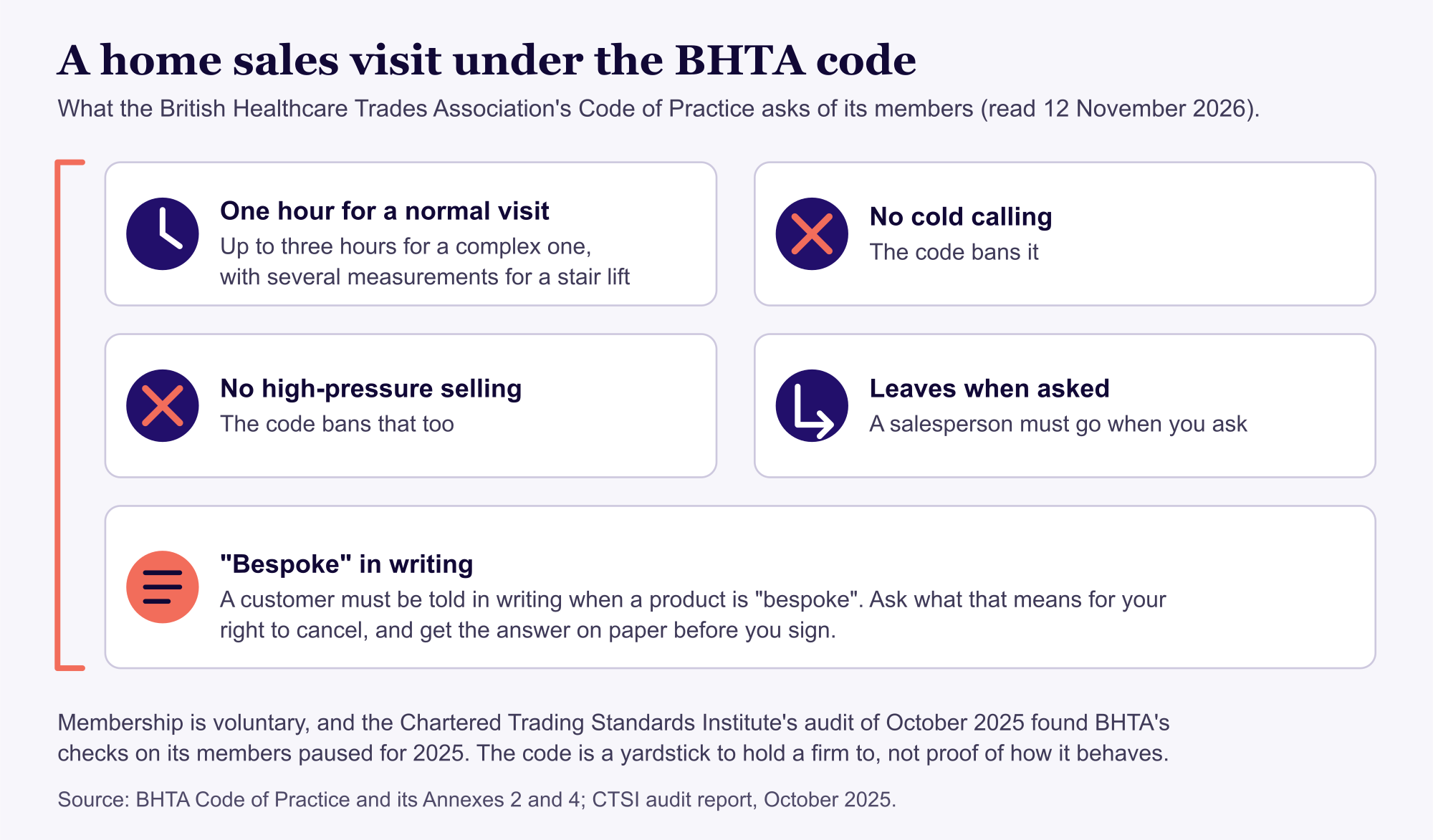
The BHTA code of practice is the British Healthcare Trades Association's code for its members, approved by the Chartered Trading Standards Institute. For a stair lift buyer the key parts are about selling: it bans cold calling and high-pressure selling, says a salesperson must leave when asked, limits a normal home sales visit to one hour, and says you must be told in writing when a product is "bespoke".
Its limits matter as much: membership is voluntary, and an audit in October 2025 found the association's checks on its members paused for 2025. Use the code as a standard to hold a firm to, not as proof of how it behaves.
Who the code covers
The code applies to firms that are members of the British Healthcare Trades Association (BHTA). Members sign up to it, and the Chartered Trading Standards Institute (CTSI) approves it (CTSI, read 12 Nov 2026). Firms that are not members have not signed it. CTSI's audit put BHTA members' share of stair lift provision at about half (CTSI audit, read 12 Nov 2026), so many firms you might meet are outside it.
What the code says about selling
The code has annexes for particular situations: Annex 2 covers off-premises sales, such as a sale in your home, and Annex 4 covers consumer fairness (BHTA Code of Practice, read 12 Nov 2026). The points that matter at a stair lift sale:
- No cold calling. A member should not call or knock unannounced to sell you a stair lift.
- No high-pressure selling. The code bans it.
- Leaving when asked. A member's salesperson must leave when you ask.
- The length of a visit. One hour for a normal home sales visit; up to three hours for a complex visit with several measurements for a stair lift.
- "Bespoke" in writing. A customer must be told in writing when a product is "bespoke".
Why "bespoke in writing" matters so much
The law on cancelling excludes "goods that are made to the consumer's specifications or are clearly personalised" (regulation 28, read 13 Nov 2026), and where there is no right to cancel the firm must tell you so before you are bound (Schedule 2, paragraph (o), read 13 Nov 2026). No official source says how that exception applies to a stair lift. The code's requirement to tell you in writing when a product is "bespoke" is the practical link between the two: if a member firm says your lift is bespoke, you should see that word on paper before you sign, and ask what it means for cancelling. Cancellation rights sets out the law's words.
The limits of the code
Three things to keep in mind before relying on it:
- Membership is voluntary. A firm that is not a member has signed up to none of this, and about half of stair lift provision was outside BHTA membership on CTSI's figure.
- Checks were paused. The Chartered Trading Standards Institute's audit of October 2025 found BHTA's checks on its members paused for 2025 (CTSI audit, read 12 Nov 2026).
- A code is not the law. Your legal rights come from the regulations and consumer law, whether or not a firm is a member. The code adds standards on top; it does not replace them.
So the right way to use the code is as a yardstick: something specific to quote back to a salesperson ("your code says a normal visit is one hour") and to point to if you complain. It is not a badge of good conduct, and this site shows no BHTA or CTSI badge and claims no membership of its own.
How to use it as a buyer
- Ask the firm whether it is a BHTA member, before the visit. Note the answer.
- Hold the visit to the code's limits. Say at the start how long you have. Home sales visits covers how to end one.
- Ask for "bespoke" in writing. If the firm says the lift is made for you, ask what that means for cancelling, on the order form.
- If something goes wrong, use the code in your complaint. Citizens Advice's steps for a consumer problem include contacting the trade association or quality scheme a firm belongs to, after the firm's own complaints procedure (Citizens Advice, read 13 Nov 2026). The complaint route sets out every step.
The before-you-sign checklist includes the questions to ask about membership and the visit.
Where this page's information comes from
The code's terms on this page were read on BHTA's own Code of Practice page and on the Chartered Trading Standards Institute's page for the code on 12 November 2026, as were the audit findings in CTSI's report of October 2025. Before you quote a detail in a complaint, check it against the current version on BHTA's website.
Where this comes from
Every rule, figure and quotation on this page comes from one of these, read on the publisher's own website on the date shown. How the sources are chosen and checked.
- British Healthcare Trades Association: BHTA Code of Practice, with Annex 2 (off-premises sales) and Annex 4 (consumer fairness)
- Chartered Trading Standards Institute: Approved codes of practice: British Healthcare Trades Association
- Chartered Trading Standards Institute: BHTA audit report, October 2025 (PDF)
- Citizens Advice: Solve an ongoing consumer problem with a business seller
- legislation.gov.uk: Consumer Contracts (Information, Cancellation and Additional Charges) Regulations 2013, regulation 28: limits of application
- legislation.gov.uk: Consumer Contracts Regulations 2013, Schedule 2: information relating to distance and off-premises contracts
Get a stair lift quote
Say what the stairs are like and what you have in mind. The reply comes by email, and asking does not commit you to anything.
What happens next
- Your message reaches SEO Dons Ltd, the publisher of this site.
- We reply by email about getting a quote for the stairs you describe, usually with a question or two.
- There is no obligation: nothing is booked and nobody comes to your home unless you ask for that yourself.